

Computing
Intent
Kapow Primary’s Computing scheme of work aims to inspire pupils to become curious and explorative thinkers with a diverse knowledge of the world – in other words, to think like computing experts. The intention is for pupils to develop the confidence to question and observe places, measure and record necessary data in a variety of ways and analyse and present their findings.
The scheme aims to build an awareness of how computing shapes lives at multiple scales and over time. The hope is to encourage pupils to become resourceful, active citizens who will have the skills to contribute to and improve the world around them.
The scheme supports teachers in developing their subject knowledge and skills, enabling the delivery of engaging, well-informed lessons with confidence. The curriculum is designed to be both accessible and ambitious, ensuring all learners’ full participation and potential achievement.
The three strands
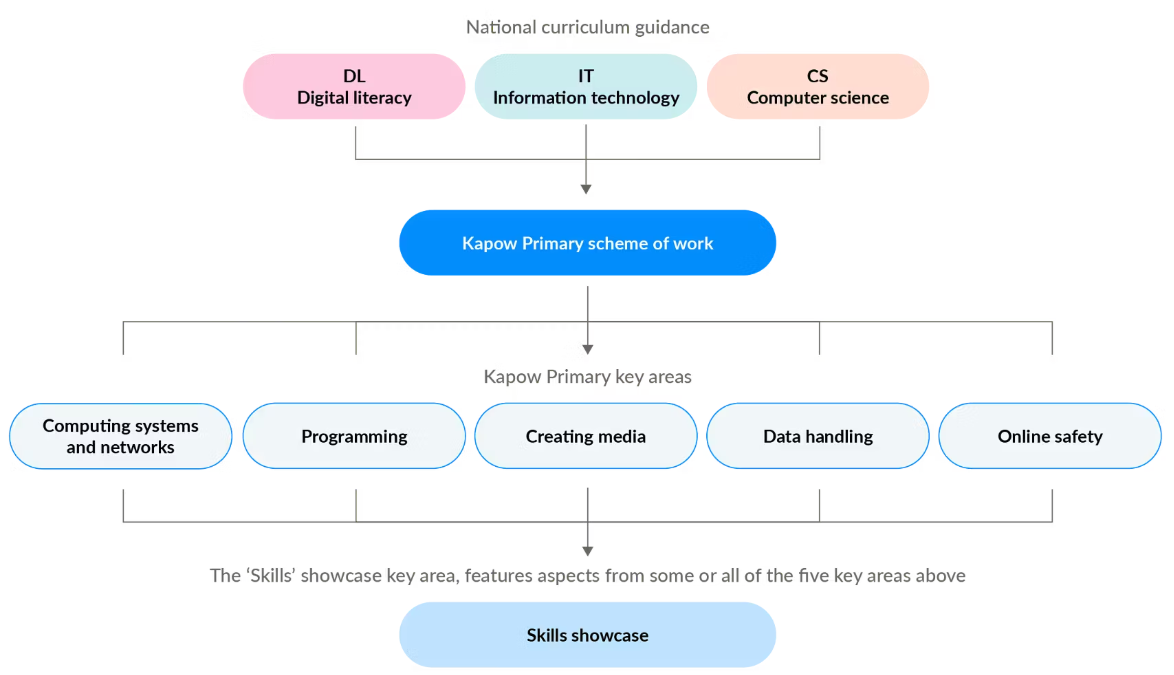
The National curriculum organises the attainment targets for Computing under three strands:
- Computer science.
- Information technology.
- Digital literacy.
Kapow Primary’s Computing curriculum has been structured to ensure these strands run through each unit.
These strands ensure a balanced coverage of the different aspects of computing, supporting the development of both substantive knowledge (e.g understanding networks, algorithms and data) and disciplinary knowledge (e.g. applying skills to program, creating digital content and evaluating online information responsibly).
Spiral curriculum
Kapow's Primary Computing scheme of work has been designed as a spiral curriculum with the following key principles in mind:
- Cyclical – pupils return to the key knowledge and skills again and again during their time in primary school.
- Increasing depth – each time a skill is revisited, it is covered with greater complexity.
- Prior knowledge – pupils build upon previous foundations rather than starting again.
Implementation
We aim to teach computing 1 hour a week, which meets the needs of the National Curriculum.
Kapow Primary supports teachers in delivering the Computing curriculum effectively through clear and informative CPD videos.
These videos are designed to help teachers feel confident in their role by providing guidance on key concepts, teaching strategies and best practices.
Lesson Structure
Recap and recall
Each Computing lesson begins with a short activity revisiting prior learning. This helps reinforce key knowledge, activate long-term memory and create connections between past and new learning.
Recap and recall activities are varied to keep the start of the lesson engaging and fun while still supporting active recall.
Attention grabber
A short, engaging activity designed to hook pupils into the new learning in the lesson.
This could be a thought-provoking question, a quick investigation or an interactive discussion to spark curiosity and enthusiasm for the topic.
Main event
The core part of the lesson, where children engage in activities that develop their understanding of the learning objective.
This includes a mixture of teacher modelling, guided practice and independent or collaborative tasks tailored to support all learners.
Wrapping up
A final reflective activity that consolidates learning.
This could involve reviewing the success criteria, discussing key learning or applying knowledge in a different context to assess understanding and encourage deeper thinking.
The Kapow Primary Computing scheme of work is designed to be fully adaptable for pupils with SEND. Every lesson includes an adaptive teaching section, providing clear guidance on how activities can be modified to meet the needs of all learners.
Kapow Primary’s Computing scheme supports cross-curricular learning by making clear connections between subjects, helping pupils develop a broader understanding of key concepts and skills.
Cross-curricular links are explicitly highlighted: each unit includes identified cross-curricular connections, detailed in the unit hub and long-term plans. These allow teachers to integrate learning across different subjects.
In addition, each lesson has a cross-curricular links section that shows the links to the National curriculum in subjects other than Computing.
Impact
Formative Assessment – Kapow Primary Computing lessons include ongoing assessment opportunities, such as questioning, retrieval practice and interactive activities.
These enable teachers to assess understanding in real time and adapt their teaching accordingly.
Summative Assessment – Each unit provides an Assessment quiz and Knowledge catcher, which allow teachers to measure pupils’ understanding at key points.
These tools help gauge how well pupils have retained key knowledge and skills over time.
Written outcomes
Pupils demonstrate their learning and provide tangible evidence of progress through a variety of activities, including structured written work, code structures and creative responses.
Pupil voice
Lessons encourage discussion, reflection and verbal explanations. This allows teachers to capture pupils’ understanding through questioning, class discussions and recorded responses, supporting a broader view of progress beyond written work.
Teacher confidence
Kapow Primary’s Computing scheme is designed to boost teacher confidence and support whole-school improvement by providing high-quality, accessible resources that empower teachers to deliver engaging and effective lessons.
The scheme supports teacher confidence using:
- Clear lesson plans and subject knowledge support – step-by-step guidance ensures teachers feel well-prepared, even if they are not subject specialists.
- CPD videos – short, expert-led training videos help subject leaders develop their expertise and support their colleagues.
- Adaptive teaching strategies – practical suggestions for differentiation ensure that teachers can confidently meet the needs of all learners.
School improvement
Kapow Primary’s Computing scheme supports school improvement using:
- Consistent, high-quality teaching – a structured scheme ensures a coherent approach across year groups, supporting curriculum progression.
- Assessment and evidence tracking – built-in assessment materials help teachers monitor progress and demonstrate impact.
- Alignment with Ofsted expectations – the scheme supports personal development, broadens pupils’ horizons and ensures a knowledge-rich curriculum, helping schools meet inspection criteria.
By reducing workload, building teacher expertise and ensuring high teaching standards, Kapow Primary contributes to a confident teaching staff and a well-structured, effective curriculum that supports whole-school improvement.